We do not simply drill
deeper. We understand
what lies beneath.
Groundwater engineering begins long before a drill bit enters the ground. Every successful well is one connected process — hydrogeological study, geophysical investigation, electronic well logging, formation-specific drilling, scientific well design, development, testing and, increasingly, groundwater recharge. The objective is not merely to reach water. It is to understand the aquifer, construct the well correctly, protect the quality of the groundwater, and build a source that performs for decades.
Decisions made on the
geology below the site —
not assumptions above it.
Every formation behaves differently. Sand, gravel, boulders, fractured rock and consolidated strata cannot be approached with the same method — and most failed bores are not bad luck, but the wrong method used on ground that was never going to accept it.
Before a drilling location is fixed, hydrogeological studies examine the surrounding aquifer system, its recharge behaviour and the performance of existing wells. Geophysical investigation then uses resistivity and allied equipment to interpret the subsurface formations to depths of up to 760 metres, cross-checked against the hydrogeology before the first metre is drilled.
An underground diagnostic
of the aquifer.
Once a bore has been drilled, electronic well logging reveals what the bore has actually encountered. Much as a doctor reads diagnostic signals to understand what is happening inside the body, a well logger reads the changing character of the earth down the full depth of the bore. Our EL 600 electronic loggers demarcate the granular water-bearing zones and establish precisely where the groundwater-bearing formations occur.
The resulting log becomes the engineering blueprint for the well: where the screens should be positioned, how the casing should be designed, what slot sizes are required, and where the gravel pack should be placed.
One engineering principle:
match the machine to
the formation.
No single machine is ideal for every geological condition. Our fleet has been developed around the ability to select the correct method for the ground encountered — which is why our wells come in.
0–800 ft
Percussion · Japanese tubular bit
A proven mechanical method, and still the right tool for straightforward formations and schemes where simplicity and reliability matter most. Three rigs in service.
up to 2,500 ft
Direct rotary
Drilling fluid circulates down the drill string and returns through the annular space, carrying cuttings back to the surface. Efficient in consolidated formations, with large-diameter bores to 26 inches.
up to 2,500 ft
Reverse circulation rotary
Cuttings travel upward through the drill pipe rather than around it — cleaner formation samples, greater bore stability, and controlled access to deep, undisturbed aquifers where water quality holds and yield lasts. We introduced the first machine of this type in India.
up to 2,500 ft
Dual Rotary · Foremost DR-24 HD
Two independent rotary drives operate simultaneously — one advancing the outer casing while the second drills inside it. The reason we can work ground that stops other contractors. Detailed below.
~3,200 ft
In-house reverse rotary — built by us
Designed and fabricated by our own engineering team in Punjab: twin engines at 300 HP for air and 175 HP for vacuum, a complete hydraulic system, and a 30-inch bore driven to roughly a kilometre. Nothing else in the country does this.
Two drives. One hole.
Cased as fast as it
is cut.
The Dual Rotary has been proven worldwide since 1979, and Gurnam Singh & Company was the first to bring one into India.
Loose sand, gravel, boulders and unstable overburden can collapse around a conventional bore before casing can be installed — the hole fails before the casing arrives, and the job is lost. Dual Rotary changes the sequence completely: the lower rotary drive advances and rotates the steel casing while the upper drive independently drills inside it. The bore is supported as it is created.
The lower drive works through a carbide-studded shoe welded to the casing bottom, cutting through boulders and hard formations on its own, while the top drive runs a down-the-hole hammer, drag bit or roller cone within. Because the two drives feed independently, the bit can run flush with the casing shoe for maximum penetration — or the casing can be pushed ahead of the bit in heaving formations to keep the hole under control. Once the casing is set, the same rig simply continues in open hole. No tripping out, no changing tools.
What that delivers on a job
Straighter wells. Rotating the casing rather than hammering it produces a controlled bore geometry, which reduces stress on casing welds and greatly simplifies screen and pump installation.
Protected aquifers. Advancing casing isolates the upper formations as the bore deepens — the shallow polluted layer never gets a path down to the deep clean one.
Controlled cuttings. Drilled material rises between drill pipe and casing and exits through a discharge swivel, directed to a chosen containment point. On populated sites and environmentally sensitive ground, that matters.
Speed through the impossible. Independent observation puts Dual Rotary at roughly 20–40 minutes per 20 feet in sand and gravel, against 45–90 minutes for conventional air rotary and several hours for cable tool. In the Kandi belt, that is the difference between a 2,500 ft well in about fifteen days and one in three to four months.
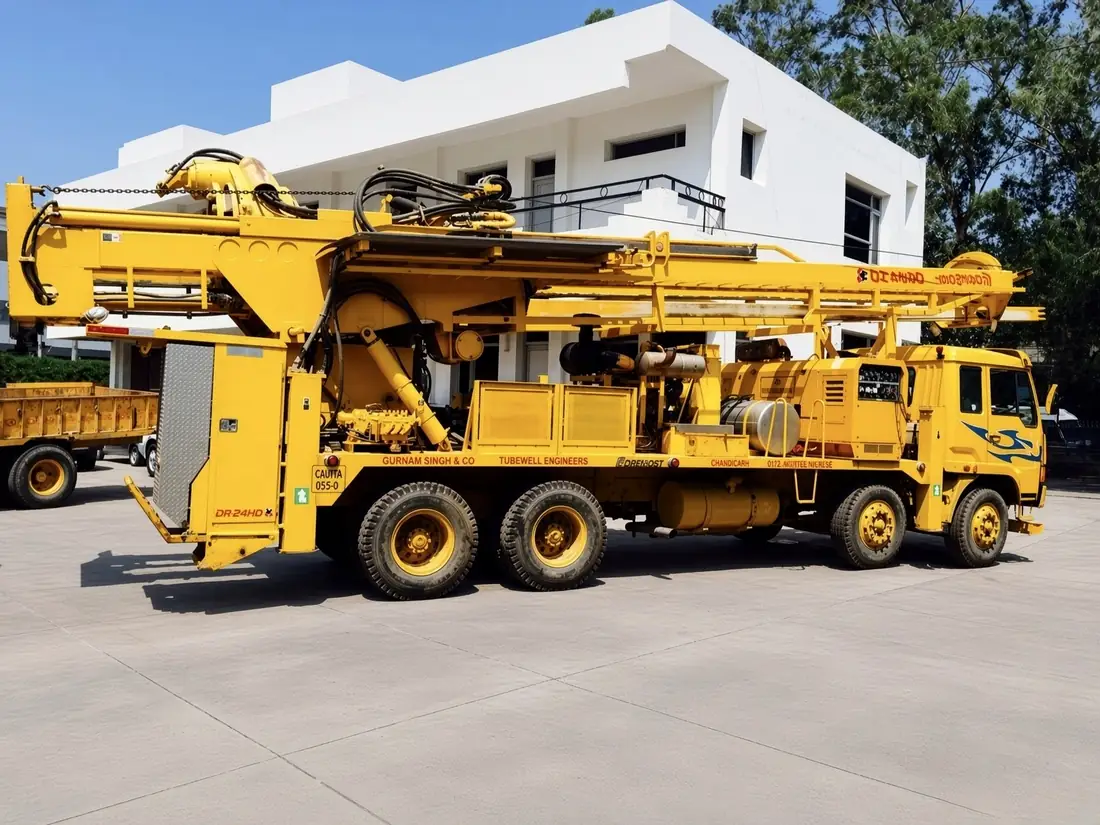
The Foremost DR-24 HD at Chandigarh — lower drive and casing table forward, top drive on the mast, 1,250 cfm compressor amidships. The first Dual Rotary rig in India.
| Maximum casing diameter | 24 in · 610 mm |
| Top drive stroke | 26 ft · 7.92 m |
| Top drive pullback | 80,000 lb · 36,300 kg |
| Top drive torque | 14,000 ft-lb · 18,900 Nm |
| Lower drive pullback | 118,000 lb · 53,500 kg |
| Lower drive torque | 2,500,000 in-lb |
| Compressor | 1,250 cfm @ 350 psi |
| Engine power | 675 hp · 503 kW |
| Operating weight | 105,000 lb · 47,630 kg |
Manufacturer's published figures for the DR-24 HD. Actual performance varies with formation.
Survey. Drill. Log.
Design. Develop. Test.
Reaching groundwater is only one stage of the process. Each step informs the next — and together they turn a hole in the ground into a source that will still be yielding in twenty years.
Hydrogeological survey
Desk study and field investigation of the aquifer system, its recharge behaviour, and the yields of existing wells across the site and its surroundings.
Geophysical investigation
Resistivity and allied equipment infer formation type down to 760 m, interpreted with current software and cross-checked against the hydrogeology before a location is fixed.
Electronic well logging
Our EL 600 loggers demarcate the granular zones down the completed bore, confirming both the quality and the quantity of groundwater actually available.
Scientific well design
Screen placement, slot size, gravel pack and casing schedule are designed to the logged profile — which is what turns a borehole into a well.
Development and testing
Over-development pumps to 125 HP and compressors from 450 to 1,400 CFM clear fine material from the formation and prove the yield before handover.
Supply and connection
Pump installation, pipeline laying, storage, tankers and the village-level distribution that carries the water to a household tap.
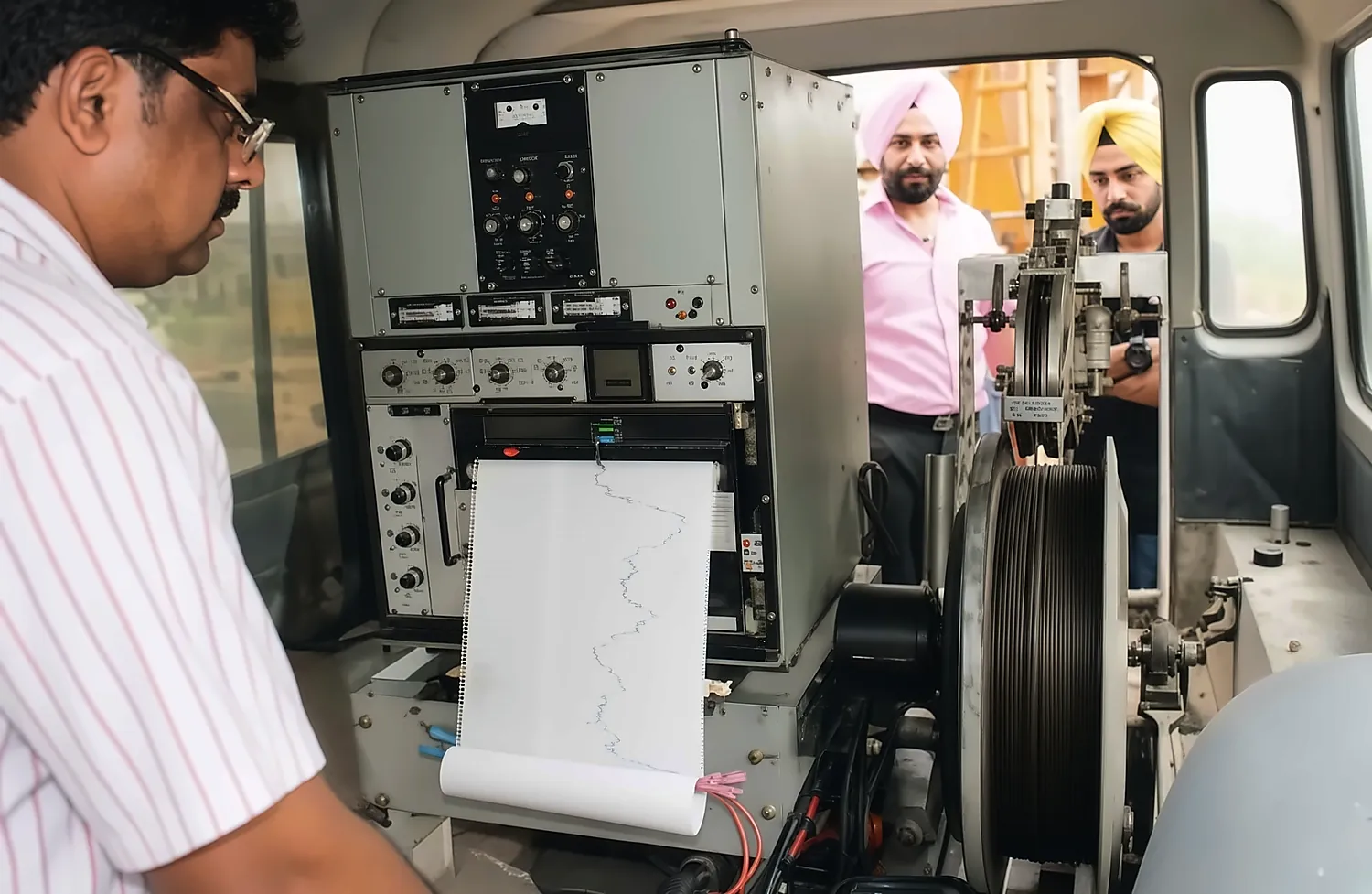
Step 03, on the day. The log printing out inside the unit — the sonde on the winch to the right, the trace on the chart to the left. Every kink in that line is a change of formation, and the well is designed around it.
A borehole tells you nothing until it is logged. The sonde is lowered on the cable, the recorder draws resistivity and self-potential against depth, and what comes off the chart is the actual granular profile of the ground — where the sand and gravel lie, where the clay bands sit, which zones will yield and which will only take up screen. Screen depth, slot size, gravel pack and casing schedule are then set to that chart, not to habit. It is the difference between a hole that gives water this year and a well that is still giving it in twenty.
The well is where the
work begins. The tap
is where it ends.
For our first decades, the job was finished when the water came up. Today it is finished when the water comes out of a tap — in a kitchen, in a school, at the far end of a state.
Extraction was only ever half the problem. Water at the wellhead is worth nothing to a household forty kilometres away, and so the company grew into everything that stands between the two: pumping stations, rising mains, storage reservoirs, and pipeline networks that carry water from the aquifer to the doorstep.
Where the pipes have not yet reached — drought-prone blocks, water-stressed settlements, sites cut off by terrain — our tankers carry the water instead, so that no one waits on infrastructure to drink. And under the national programmes we build for — Jal Jeevan Mission's Har Ghar Jal in Jammu & Kashmir, AMRUT, the Smart Cities Mission, World Bank rural schemes in the hills — that infrastructure now reaches every household across entire states.
The measure of it is simple: five hundred million gallons a day, moving from our wells through our pipelines into homes, farms, industry and defence establishments. Not water found — water delivered.
The well
Surveyed, drilled, logged, designed, developed and tested — the source itself, built to yield for decades. The first link in the chain, and for years the only one.
Pipelines & tankers
Pumping stations, rising mains, storage and distribution networks — and tanker fleets for the places pipes have not yet reached. The water goes where it is needed, not where it happens to be.
Every household
Village-level distribution down to the individual tap connection, built under Har Ghar Jal and allied programmes — complete water infrastructure, source to spout.
Seventy years bringing
water up. Now we engineer
the journey back down.
Groundwater recharge is not a gesture towards the environment. It is the only engineering that can keep northern India's aquifers alive — and the same knowledge required to extract groundwater successfully is now being applied to putting it back.
Every monsoon, enormous quantities of rainwater fall onto rooftops, campuses, roads, courtyards and agricultural land — and most of it becomes surface runoff that disappears through drainage systems within hours. That is water the land has already been given, and thrown away, in the same season its farmers pump the aquifer a little lower. A scientifically designed recharge system captures part of that resource and returns suitable water underground.
Harvest the rain
Rainwater and surface runoff are collected close to where they fall — the one source of water that costs the aquifer nothing.
Clean it first
Desilting chambers and engineered filtration remove sediment and unwanted material before recharge — what goes down must be clean.
Read the formation
Hydrogeology, geophysical investigation and decades of drilling data determine which underground formation can safely and effectively receive the water.
Send it down
Purpose-built recharge wells, shafts and pits — sealed through the upper formations — guide the filtered water toward the receptive strata.
Refill the aquifer
Instead of being lost as runoff, the captured water re-enters the groundwater system — the water table rises, and every well drawing from it recovers together.
The borewell — reimagined
There is something remarkably elegant about groundwater recharge. For generations, borewells have been engineered to bring water from the earth to the surface. Recharge engineering applies the same disciplines in reverse — drilling, geology, casing, filtration and the reading of underground formations, all used to help suitable water travel from the surface back into the earth.
And that distinction matters. Recharge cannot simply mean drilling a hole and letting water disappear underground. The receiving formation must be understood, surface contamination must be controlled, filtration must be engineered correctly and the upper formations must be properly sealed. A recharge structure built blind can do more harm than none at all. Built on knowledge, it restores the aquifer for everyone drawing from it.
Engineering water for the next generation
The future of groundwater cannot be measured only by how efficiently water is extracted. It must also be measured by how intelligently the aquifers on which communities depend are understood, protected and replenished. Our technology therefore serves two directions: finding water when society needs it, and returning water when nature provides it.
That is the evolution from groundwater drilling to groundwater engineering — from simply accessing an aquifer to helping secure it for generations to come.
Why this matters for Punjab — and what we are asking its water authorities to require — is on the Environment page.